


What does ‘Brick Lane’ refer to?
Brick Lane is a street in the East London borough of Tower Hamlets, which runs from Bethnal Green to Whitechapel High Street. The southern half of the street was formally recognised as London’s ‘Banglatown’ in 1997, and Brick Lane’s reputation as home to, and a cultural centre for, Bangladeshi people is so widely recognised that the electoral ward of Spitalfields was changed to ‘Banglatown and Spitalfields’ in 2002.
Tower Hamlets is home to the largest concentration of Bangladeshis in Britain, and census data from 2011 recorded that 32% of its population were of Bangladeshi ethnicity. 57% of the borough’s children were of Bangladeshi descent, and 18% of residents spoke Bengali as their first language.[1]
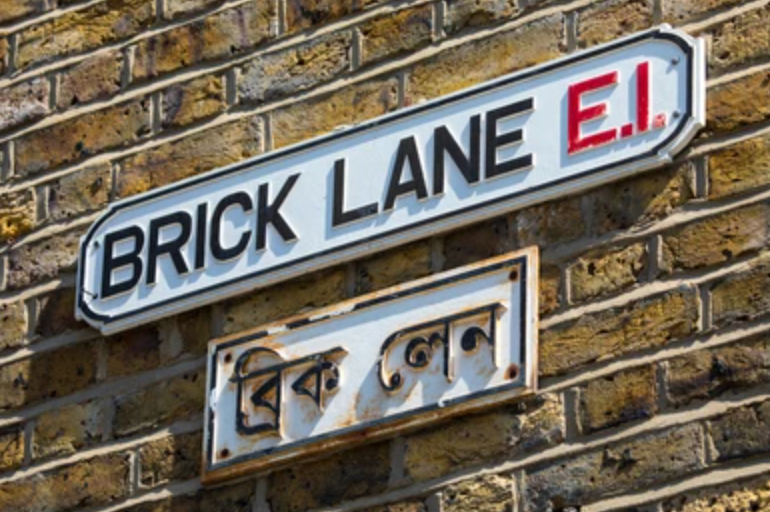
In Banglatown, street names are written in both Bangla and English and lampposts are painted the green and red colours of the Bangladeshi flag. Brick Lane is home to the annual Brick Lane Festival, which celebrates the various cultures that have contributed to the area, as well as the Boishakhi Mela Festival, the largest Bengali festival in Europe.[2]
Important landmarks on and around Brick Lane
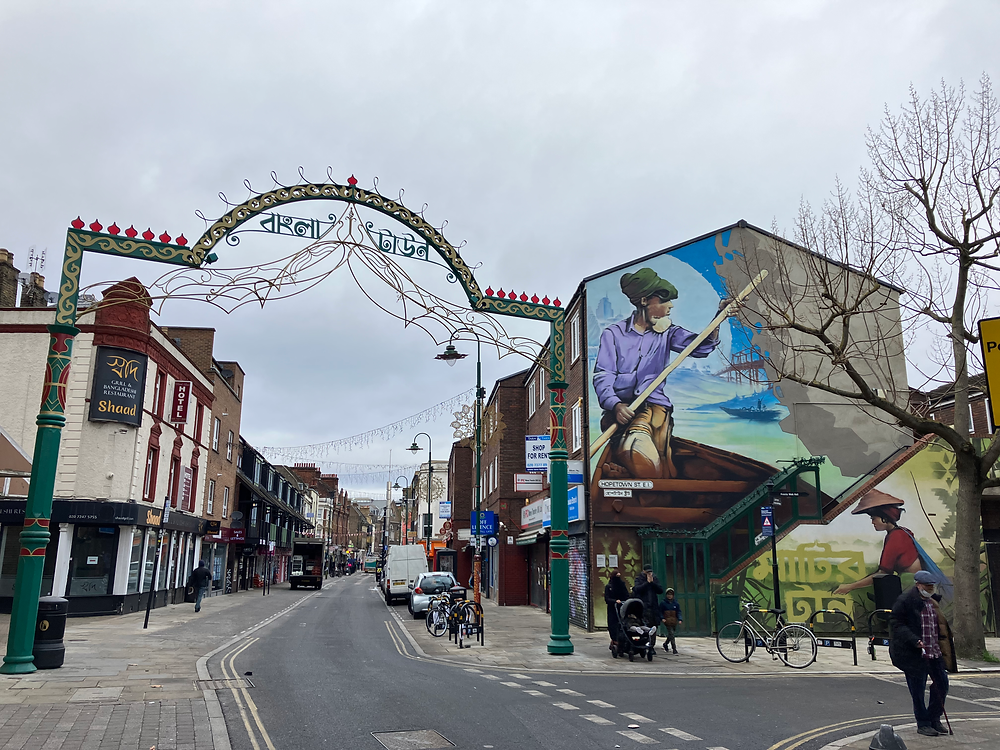
The Brick Lane Arch was erected in 1997 at Brick Lane’s intersection with Hopetown Street. Designed by Meena Thakor, it reads ‘Brick Lane’ in Bangla, and is painted in the green and red of the Bangladeshi flag.
The Great London Mosque (Jamme Masjid), on the corner of Fournier Street, has a 29-meter-high minaret, decorated with colour-changing LED lights.[3]

The Kobi Nazrul Centre was established in 1982 to support Bengali artists and projects.[4]
Mohammed Ali Aerosol’s ‘The Traveller’ mural commemorated Bangladesh’s 50th anniversary of independence in 2021. The moral paid homage to Sylhet, the region that the majority of Tower Hamlets’ Bangladeshis migrated from.[5]
Within the Atlab Ali park lives a replica of Dhaka’s Shaheed Minar, which was originally built to commemorate the lives lost during Bangladesh’s 1971 war of independence. British Bangladeshis meet at the Shahid Minar monument to commemorate International Mother Tongue Day every year.[6]
The Atlab Ali Park was originally known as St.Mary’s Park, named after its 14th-century white church, which gave Whitechapel its name.[7] In 1998, the park was renamed Atlab Ali Park in memory of the Bangladeshi man who was murdered beside it. An arch was erected at the park’s entrance in 1989, as a memorial to Atlab Ali, which incorporates Bengali-style patterns. On the path, a line of Tagore’s poetry reads ‘The shade of my tree is offered to those who come and go fleetingly’.[8] Since 2015, an annual Atlab Ali commemoration day has been hosted by the borough of Tower Hamlets.

‘Indian’ takeaways and ‘curry houses’ in the UK
Brick Lane is known for its licensed ‘curry houses’, and was the centre of development for the Anglo-Indian cuisine in the 20th century, which occurred after the industries that Bangladeshi migrants found work in (particularly the rag trade) went into decline.[9] In the last few decades, ‘curry quarters’ have developed throughout England, including the ‘Curry Mile’ in Manchester, Birmingham’s ‘Balti Triangle’ and Bradford’s ‘Curry Capital’. Foreign Secretary Robin Cook remarked in 2001: ‘Chicken Tikka Masala is now Britain’s true national dish … a perfect illustration of the way Britain absorbs and adapts external influences’.[10]
In the late 1940s, Sylheti-owned coffee shops opened on Brick Lane, catering to the migrants who moved to Britain post-1947 partition in search of work. These venues would serve kosher meat, as there was not yet halal meat available in the UK.[11] The first licensed ‘curry house’ to open on Brick Lane was Musa Patel’s The Clifton, which opened in 1967.[12] By the mid-2000s, Banglatown was home to around 60 ‘curry houses’. Today, the Indian restaurant and takeaway industry is worth more than £5 billion, and 80% of the UK’s Indian restaurants are Bangladeshi-owned.
The sector has been experiencing a decline in the last decade, which can be attributed to various factors. As food fashions change, the British public has come to seek out ‘healthier meals’, leading them to avoid takeaways, particularly ‘Indian’ takeaways, which are often tied to binge drinking culture. Britain is also developing an increased interest in ‘authentic’ South Asian cuisine, as opposed to the Anglicised dishes served in most ‘curry houses’.
History of Brick Lane
Brick Lane got its name from the brick and tile manufacturing industries, which flourished in Tower Hamlets during the 1400s, due to the brick kilns brought by early Flemish settlers.[13] Huguenots who fled from France in the 1600s settled on Brick Lane, as did the Irish fleeing the Great Famine in the 1800s and Eastern European Jews in the 1900s.
While Brick Lane has a history of cultural diversity, this diversity has a tradition of right-wing resistance. The British Union of Fascists (BUF), founded and led by Oswald Mosley, had 4,000 members in Bethnal Green, and would meet in Kerbela Street, which runs parallel to Brick Lane. In 1936, the BUF planned a march in Whitechapel to protest the area’s large Jewish population. Famously, over 300,000 protestors, including non-Jewish residents, intercepted this protest.[14]
Bangladeshi immigration to Tower Hamlets stretches as far back as the 1600s, when the East India Company was established. The East End docks imported goods from the British colonies, including tea from Sylhet and jute from Calcutta.[15] By the 1850s, around 6000 lascars were employed on British ships each year, and many would establish a home in London’s East End upon arrival. After the 1947 partition, Bangladeshi men (particularly Sylhetis) moved to Britain in search of work, joining the ex-lascar community who had already settled in London.[16]
Early Bangladeshi migrants worked in UK cotton, textile and steel mills until the 1970s, when increasing unemployment forced many to move to Tower Hamlets to work in the largely Jewish-owned ‘rag trade’. The Bangladeshi community in London grew considerably in the 1970s, from around 5000 in the early 1960s to around 200,000 in the 1980s.[17]
The number of Bangladeshi migrants in the UK peaked in the 1970s, following the conflict with what was then known as West Pakistan. The Immigration Act of 1971 (which came into effect in 1972) restricted migration from Commonwealth countries.[18] This legislation primarily allowed wives and children to join their relatives who were already in the UK, meaning that patterns of migration shifted towards family reunification (as opposed to male workers seeking employment).
The Future of Brick Lane
Post-pandemic, Brick Lane has seen a dramatic change in its storefronts. 80% of the Banglatown curry houses that have closed were replaced by new food retailers, such as Dark Sugars, a boutique chocolate shop that now sits on the site once occupied by Musa Patel’s The Clifton. On the northern end of Brick Lane, Bangladeshi restaurants are being replaced by ‘high-end’ vintage stores.
Brick Lane is surrounded by financial districts, whose employees used to frequent the Bangladeshi establishments for lunch. Due to working from home patterns, shorter lunch breaks, office canteens, and increasingly available ‘grab-and-go’ options, the retailers have lost out on this clientele. Brick Lane is also affected by generational change within the Bangladeshi community. As restaurant owners reach retirement age, they are noticing that their children are not interested in taking over the business, largely due to an understanding that the industry is currently collapsing.[19]
Some residents of Tower Hamlets feel that the gentrification of Brick Lane can do some good for the local community, adding diversity to the area, creating jobs, and increasing tourist footfall. Others feel that bureaucracy and legislation are now being used to displace and discourage their community, just as violence and intimidation were used in the 1970s.[20]
The Bangladeshi community is slowly shifting away from Brick Lane and towards Whitechapel, being displaced by gentrification and the subsequent rise of rent prices.[21] Tower Hamlets was the borough that experienced the most gentrification between 2010 and 2016.[22]
Atlab Ali, the National Front, and Bangladeshi Youth Movements
The Bangladeshi community in Brick Lane, and throughout London’s East End, have fought to create the Banglatown we know today. ‘The history of what Bangladeshis have done in that area is amazing: fighting for education, fighting for better housing, fighting to not be harassed, to walk home safely without being killed’.[23]
Atlab Ali was a Bangladeshi man who moved, with his uncle, to London in 1969. When he was murdered, on 4 May 1978, he was a 25-year-old man who worked in a clothing factory and whose wife was planning to move to London to live with him.
Ali was murdered by three teenage boys on Adler Street, outside of St Mary’s Gardens. The attack was random, and the perpetrators did not know Ali but rather targeted him for his race. The same day that Ali was murdered, the National Front gained nearly 10% of the local election votes in Tower Hamlets, rooting Ali’s murder in a context of far-right hostility.[24] When asked by a police officer why he attacked Ali, the youngest perpetrator (aged sixteen) replied ‘no reason at all’ and ‘I've beaten up Pakis on at least five occasions’.[25]
Ten days after Ali died, Tower Hamlets came to a standstill, as Bangladeshi shops and restaurants closed for the day so their owners could join the seven thousand people who marched behind Ali’s coffin. This march ended at Downing Street, calling on the government to recognise the mistreatment of the Bangladeshi community in East London.
Ali’s murder was one of many racially motivated attacks that targeted Tower Hamlets’ Bangladeshi community in the 1970s. Firsthand accounts recall bricks being thrown through the windows of Bangladeshi homes, local Bangladeshi businesses being vandalised, and stones being thrown at Bangladeshi people from rooftops.[26] In April 1970, Tosir Ali, a 50-year-old man who worked in a Tower Hamlets bar, was murdered by two skinheads.[27] In the same month, 50 skinheads rioted on Brick Lane, attacking Bangladeshi community members. No white perpetrators were charged for this event, but two Bangladeshi community members were.[28]
Enoch Powell’s inflammatory April 1968 speech gave far-right voters the confidence to act on their prejudices, inspiring a decade of targeted violence known by the perpetrators as ‘Paki-bashing’. After the ‘rivers of blood’ speech, East End dock workers protested Powell's being sacked as shadow defence minister.[29]
During the early and mid-1970s, the National Front recruited voters in Tower Hamlets, and in 1975, they established a Sunday morning sales pitch on Brick Lane. By 1978, the National Front had moved its headquarters to Shoreditch, Tower Hamlets. In the first four months of 1978, Brick Lane Mosque’s secretary, Gulam Mustafa, recorded 33 incidents of racist violence inflicted on his community.[30]
The Tower Hamlets community found limited support in the local police department. For example, during a National Front riot in 1978, Bangladeshi youths kettled and held 20 skinheads until the police arrived, but only three of these 20 were arrested.[31] Therefore, the Bangladeshi community recognised a need to mobilise. The march to Downing Street 10 days after Ali’s murder was coordinated by British-Bangladeshi youth groups, particularly the Bangladeshi Youth Movement. These groups were largely formed of second-generation Bangladeshi immigrants, who demanded to feel safe in the country in which they were born.
Bangladeshi youth groups camped out on the streets overnight so that the National Front had nowhere to stand and sell their literature the next morning, eventually forcing the National Front to move their offices away from Brick Lane. In 1982, two Bangladeshi politicians were elected to Tower Hamlets council: Nurul Haque and Ashik Ali.
References
[1] Alexander, et al, 2020
[2] https://themonsoonatbricklane.co.uk/history-of-brick-lane/#:~:text=Bangladeshi%20Community%20Brick%20Lane(post,for%20its%20substantial%20Bangladeshi%20community.
[3] McGrath, 2022
[4] https://www.towerhamletsarts.org.uk/?s=3&v=16&guide=AllAges
[5] I think that this street art has since been replaced, but it can be seen on this website: https://talk.towerhamlets.gov.uk/bricklane/news_feed/mohammed-ali
[6] https://historicengland.org.uk/research/inclusive-heritage/another-england/your-stories/altab-ali-park/
[7] The church was destroyed during the Blitz in 1940, and therefore no longer stands there
[8] https://www.towerhamlets.gov.uk/lgnl/leisure_and_culture/parks_and_open_spaces/altab_ali_park.aspx
[10] Alexander, et al, 2020
[11] ibid
[12] The first ‘Indian’ restaurant that catered to British clientele was opened in 1809 by Sheikh Dean Mahomed, the Hindoostane Coffee House, which was established in Mayfair and therefore will be explored in a separate video
[13] https://themonsoonatbricklane.co.uk/history-of-brick-lane/#:~:text=Bangladeshi%20Community%20Brick%20Lane(post,for%20its%20substantial%20Bangladeshi%20community.
[14] https://pasttense.co.uk/2018/09/24/today-in-london-anti-fascist-history-1978-blockade-against-national-front-march-on-brick-lane/;
[15] Particularly from the 1850s onwards
[16] Alexander, et al, 2020
[17] ibid
[18] Lowe, 2020
[19] Alexander, et al, 2020
[20] Ali, Taj, 2021
[21] Note that this shift towards Whitechapel predated the Elizabeth Line opening in 2022
[22] McGrath, 2022
[23] Ali, Taj, 2021 (quoting Sotez Chowdhury)
[24] The National Front are a far-right British nationalist party, currently led by Tony Martin
[25] Nye and Bright, 2016
[26] Hoque, 2018
[27] ‘skinheads’ here is used as shorthand for the group of working-class white men, often recognisable due to their shaved or close-cut hair, who were driven by their right-wing ideologies to inflict violence on the South Asian community
[28] Kaye, 2020
[29] He remained a Member of Parliament
[30] Rosenberg, 2018
[31] ibid
Bibliography
Alexander, Claire; Carey, Seán; Lidher, Sundeep; Hall, Suzi; King, Julia; Beyond Banglatown: Continuity, change and new urban economies in Brick Lane, 2020
Ali, Mishti; What Saving Brick Lane Means to British Bangladeshis Like Me, 2021
Ali, Taj; The Battle For Brick Lane, 2021
Ashe, Stephen; Virdee, Satnam; Brown, Laurence; Striking back against racist violence in the East End of London, 1968–1970
De Simone, Daniel, Riots show how the UK's far right has changed, 2024
Hoque, Aminul; Altab Ali: Bangladeshis in east London reflect on legacy of a racist murder, 2018
Levine, Alice; Forde, Matt; Hitler’s Angel, 2024 (podcast)
Lowe, Keith; Five times immigration changed the UK, 2020
McGrath, Meadhbh; Explore Bangladeshi Culture and Cuisine Along London’s Brick Lane, 2022
Nye, Catrin; Bright, Sam; Altab Ali: The racist murder that mobilised the East End, 2016
Rosenberg, David; The racist killing of Atlab Ali 40 years ago today, 2018
Solly Kaye, Lessons from a Forgotten Murder, 2020
Toth, Albert; From 1978 to Today: The Bengali community’s fight against racism, 2021
https://pasttense.co.uk/2018/09/24/today-in-london-anti-fascist-history-1978-blockade-against-national-front-march-on-brick-lane/
https://beyondbanglatown.org.uk/globe/future-of-bengali-brick-lane/#:~:text=Today%2C%20the%20London%20Borough%20of,Bengali%20as%20their%20main%20language.
https://www.joindiaspo.com/blog-posts/when-did-brick-lane-become-bangla-town
https://themonsoonatbricklane.co.uk/history-of-brick-lane/#:~:text=Bangladeshi%20Community%20Brick%20Lane(post,for%20its%20substantial%20Bangladeshi%20community.
https://historicengland.org.uk/research/inclusive-heritage/another-england/your-stories/altab-ali-park/
https://www.youtube.com/watch?v=Eyuw50IYk4A&ab_channel=ThamesTv
https://www.towerhamletsarts.org.uk/?s=3&v=16&guide=AllAges
https://www.towerhamlets.gov.uk/lgnl/leisure_and_culture/parks_and_open_spaces/altab_ali_park.aspx
https://www.theguardian.com/uk-news/2024/sep/25/local-left-behind-prey-to-populist-politics-data-2024-uk-rioters
https://en.wikipedia.org/wiki/Brick_Lane